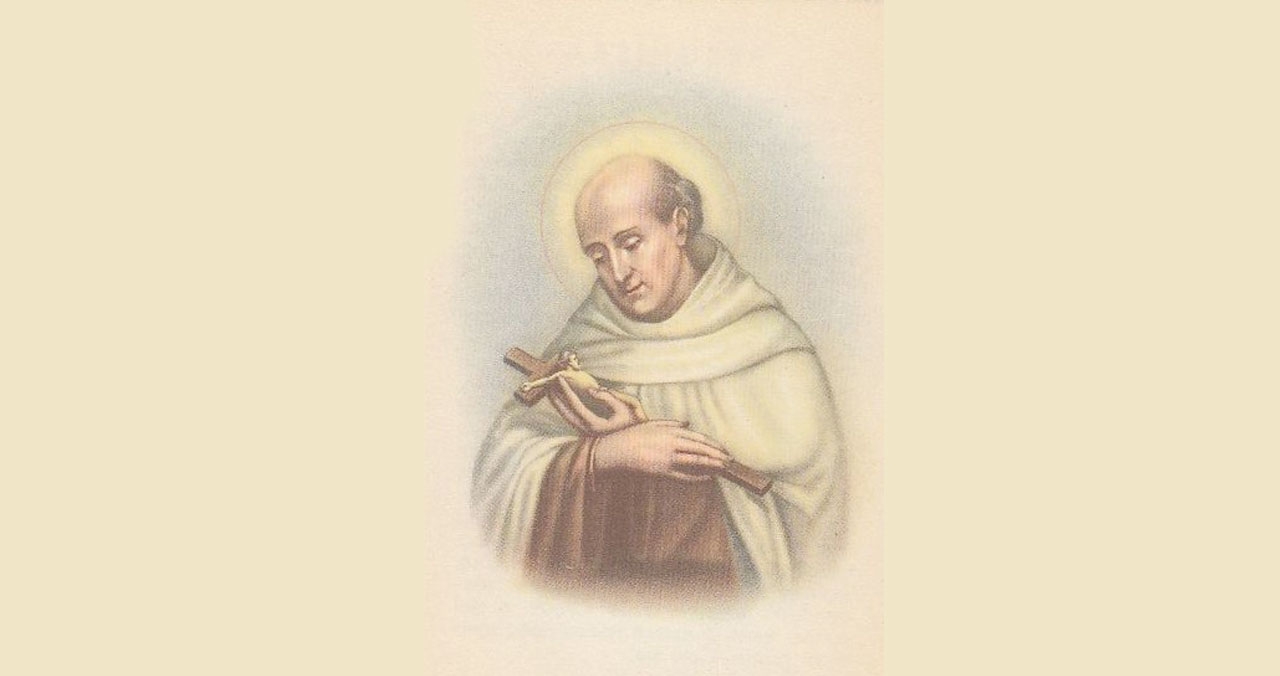
John was born in in 1542 in Fontiveros near Avila, a village in Old Spanish Castile. His father Gonzalo de Yepes was thrown out of his home and disinherited for marrying a poor silk weaver, Catalina Álvarez. Orphaned of his father at a very early age, he found himself having to move from city to city with his hardworking and active mother who was searching for their financial sustenance, thus he had to study and work in different places.
In the period between 1551 and 1559 he had cultural and artisan training in the «College of Doctrines» of Medina del Campo (today in the province of Valladolid), where he had moved with his mother. Later he was a carpenter, tailor, painter and carver; then an acolyte of the Church of Mary Magdalene, a clerk and assistant nurse in the Hospital of the Conception.
In 1563 he entered the Carmelite Order. Between 1564 and 1568 he completed his theological and philosophical studies at the University of Salamanca. In 1567 he was ordained a priest.
In October 1567, he met Teresa of Avila who was implementing a reform of Carmel. On August 9, 1568, after many talks with Teresa of Avila, he left for Valladolid where Teresa was to found a monastery of Discalced Carmelites. Here he remained until October, inquiring about and observing in detail the new reformed life. At the beginning of October, he went to Duruelo (Segovia), where he adapted a farmhouse as the first monastery of Discalced Carmelite friars. On 28 November, the first Sunday of Advent, he inaugurated the Reformed life there; on that occasion, he took the name of John of the Cross.
Between 1572 and 1577, he worked as a confessor and spiritual guide to the Monastery of the Incarnation of Ávila. On December 2nd 1577, he is arrested and imprisoned in the prison of the convent of the Carmelites of the Ancient Observance in Toledo. He remained captive for more than eight months, subjected to physical, psychological and spiritual ill-treatment, yet finding the inspiration to compose some of his most famous mystical poems. He finally managed to escape, on August 17, 1578.
In 1591, he was discharged from his leadership duties in the Order and being ill, on September 28 he went to Úbeda (Jaén), where he spent the last months of his life. Here he died, between Friday 13th and Saturday 14th of December 1591, at the age of 49. Since 1593, his incorrupt remains rest in Segovia.
The beatification ceremony was held in 1675. The solemn ceremony of canonization on December 27, 1726. In 1926, he was conferred the title of «Doctor of the Church».